
Transforming Biomedical Research with Open Biomedical Ontologies and Semantic Web Technology
At Omnibond®, we are committed to pushing the boundaries of computational solutions to address complex challenges in biomedicine. One of the most promising advancements in this field is the integration of Open Biomedical Ontologies (OBOs) with Semantic Web computational technology, which together hold the potential to revolutionize knowledge-based interpretation of biomedical research results.
The Open Biomedical Ontologies (OBOs) represent a collaborative effort to create a standardized, interoperable framework for organizing and defining biomedical knowledge. This diverse, mostly orthogonal collection of ontologies hierarchically structures concepts across a wide range of domains, including:
- Biological processes: From cellular metabolism to organism-level functions.
- Cell types: Detailed classifications of cellular structures and their roles.
- Phenotypes: Observable traits and characteristics of organisms.
- Diseases: Structured definitions for medical conditions and their relationships.
- Chemicals: Standardized representations of molecular entities.
The OBO Foundry's mission is to develop a family of interoperable ontologies that ensure consistency, clarity, and reusability across biomedical research. By providing a shared vocabulary and logical framework, OBOs enable researchers to annotate, share, and analyze data with unprecedented precision.
Despite their potential, recent work has highlighted challenges in the distributed and loosely coupled nature of OBO development. Each ontology is typically authored by a distinct research group, which, while fostering specialization, has led to unintentional conflicts and logical inconsistencies between ontologies. These inconsistencies can manifest as:
- Overlapping Definitions: Different ontologies may define similar concepts in conflicting ways, leading to ambiguity.
- Logical Inconsistencies: Discrepancies in hierarchical relationships or logical rules that prevent seamless integration.
- Interoperability Barriers: Inconsistencies that hinder the unified use of OBOs as originally intended.
These challenges underscore the need for enhanced coordination and computational tools to detect and resolve conflicts, ensuring that OBOs and similar systems can function as cohesive, interoperable ecosystems.
Figure 1: Heatmap illustrating relationships and potential conflicts across OBO ontologies. Rows and columns represent individual ontologies (e.g., GO for Gene Ontology, Uberon for anatomical structures, CL for cell lines, etc.). Gray cells indicate no direct relation or overlap; yellow cells suggest potential alignments or mappings; red cells highlight areas of conflict or inconsistency in definitions and hierarchies.
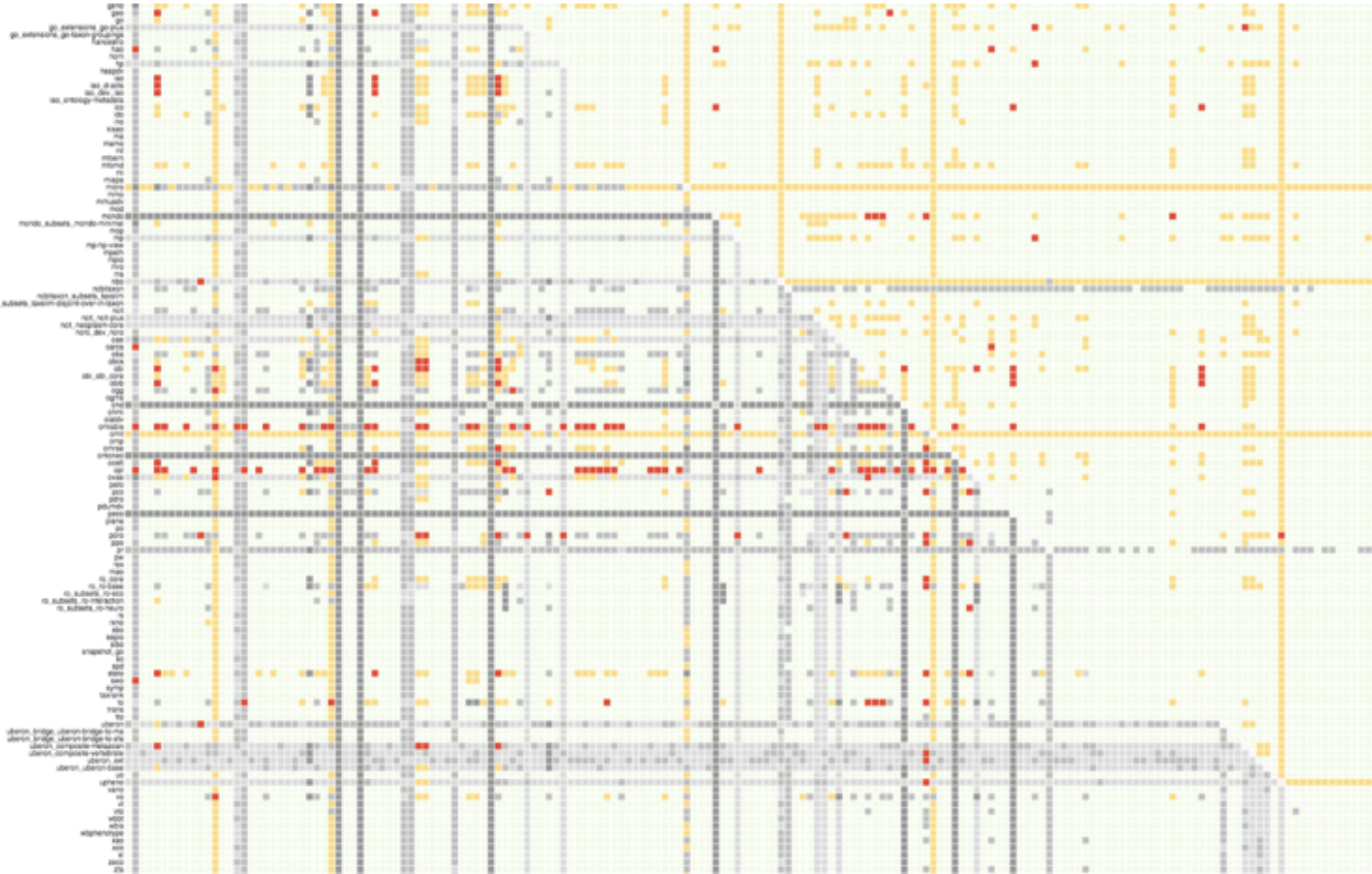
This heatmap provides a comprehensive view of the OBO ecosystem, revealing the extent of interconnections and the hotspots of logical discrepancies that arise from decentralized development.
Courtesy of the University of Colorado Anschutz Medical Campus, School of Medicine.
The Semantic Web, with its suite of technologies such as RDF (Resource Description Framework), OWL (Web Ontology Language), and SPARQL, complements OBOs by enabling machine-readable, interconnected data ecosystems. These technologies allow biomedical data to be linked, queried, and analyzed in ways that transcend traditional database limitations. By representing knowledge in a structured, standardized format, Semantic Web tools facilitate:
- Interoperability: Seamless integration of heterogeneous datasets from different research groups.
- Automated Reasoning: Logical inference to uncover hidden relationships and patterns in data.
- Scalability: Efficient handling of vast and complex biomedical datasets.
When coupled with OBOs, Semantic Web technologies transform raw data into actionable knowledge, enabling researchers to derive insights that were previously unattainable. Furthermore, Semantic Web tools can help address OBO inconsistencies by providing mechanisms to identify and resolve logical conflicts programmatically.
At Omnibond®, we provide cutting-edge AI and High-Performance Computing (HPC) infrastructure to support systems like OBOs and other areas of biomedical research. Our expertise in data orchestration and computational platforms empowers researchers to tackle complex challenges effectively. Our flagship initiative, Project Eureka, enhances these capabilities with a platform designed for semantic integration and AI-driven ontology management.
Omnibond®'s AI and HPC infrastructure, combined with Project Eureka, offers robust support for projects involving OBOs and similar systems. Project Eureka leverages advanced algorithms for automated ontology alignment, conflict resolution, and knowledge graph construction, enabling seamless unification of ontologies across distributed teams. Together, they assist researchers and institutions by:
- Automated Conflict Detection and Resolution: Using machine learning to scan and harmonize inconsistencies in real-time, reducing manual curation efforts by up to 70%.
- Scalable Knowledge Graphs: Building dynamic, queryable graphs that integrate OBOs and external datasets, supporting federated queries via SPARQL endpoints.
- Collaborative Development Platforms: Offering cloud-based environments powered by HPC, where multiple research groups can co-author and version-control ontologies, ensuring logical consistency from the outset.
- Custom Integration Services: Providing tailored AI and HPC solutions to specific biomedical domains, such as phenotype-disease mapping or chemical-biological process linkages, to drive project-specific outcomes.
By partnering with Omnibond® and leveraging Project Eureka, teams can overcome the barriers of decentralized ontology development, transforming potential pitfalls into opportunities for innovation and deeper insights.
This article draws on insights from leading research in the field, including contributions from Bill Baumgartner, Center for Computational Pharmacology, University of Colorado Anschutz Medical Campus.
The synergy of OBOs and Semantic Web technology represents a paradigm shift in how biomedical knowledge is organized, shared, and interpreted. While challenges in OBO development persist, Omnibond® is dedicated to addressing these through innovative AI and HPC solutions. We are proud to be at the forefront of this transformation, developing tools that empower researchers to unlock the full potential of their data. As we continue to innovate, we invite the biomedical research community to join us in exploring the possibilities of this powerful ecosystem.

Omnibond's Pioneering AI Solutions: A Spotlight on TrafficVision
Omnibond’s TrafficVision® leverages AI and computer vision to revolutionize traffic management across North America, enhancing safety and …

Omnibond's AI Innovation: Spotlight on BayTracker
Omnibond’s BayTracker leverages AI and computer vision to optimize quick-service operations, enhancing efficiency and customer satisfaction …
Transforming Biomedical Research with Open Biomedical Ontologies and Semantic Web Technology
Omnibond® integrates Open Biomedical Ontologies with Semantic Web technology to revolutionize knowledge-based interpretation in biomedicine.

GCP Hurricane Simulation Scale
Powered Clemson University’s record-breaking 2.1M VCPU simulation on GCP—processing 210TB of traffic video for hurricane evacuations.